

Photo by Jose Manuel Gonzalez Lupiañez Photography on pexels.com
Jennifer Beightley1 and Lauren Azevedo1
1University of North Carolina at Charlotte, USA
Much like North Carolina is a political microcosm of the United States, our nonprofit sector within the state may be a microcosm of the American nonprofit landscape. North Carolina is a compelling paradox of study because not only does it consist of large hospital networks, competitive universities, and vital rural human services, it also operates within a unique purple tension. The space between a Democratic governor and a Republican legislature means politics, and currently diversity, equity, and inclusion (DEI) ride a pendulum between the two. This pendulum space creates a distinctive environment where policy shifts have immediate, tangible effects on those dependent on government funding. Studying how North Carolina nonprofits adapt to this volatility around them at varying levels offer state-level understanding, but it may also offer broader insight into how the nonprofit sector across the country responds to a swinging political environment.
The DEI political pendulum swung left in the second half of 2020, propelled by movements and events such as Black Lives Matter, the murder of George Floyd, and #MeToo. It stayed left as President Joseph R. Biden took office in January 2021. Biden’s administration placed heavy emphasis on advancing DEI initiatives within the federal government, issuing 11 DEI-related Executive Orders in his first year in office. The DEI pendulum then began its swing to the right in the summer of 2024 when companies like John Deere and Harley Davidson announced they were discontinuing their DEI programs and DEI had become a pejorative term applied by some legislators to Kamala Harris, the first Black, Asian American, and female Vice President. And, the North Carolina higher education system had recently been affected by the Supreme Court decision in the Students for Fair Admissions vs. Harvard College, having been ordered to no longer use race in admissions. The timing of our study of North Carolina’s nonprofits and their commitment to DEI landed here, and provided unmistakable political and social context.
What we did
Our survey study inquired about nonprofit organization’s commitment to policies, practices, and activities related to DEI. We asked how controversial DEI activities are in their organization, in their community, and in the state. Curious about their response to such controversies, we asked if they made a public statement about DEI, had they communicated with public officials about DEI, received push back from stakeholders about organizational DEI initiatives, communicated with funding recipients or applicants about DEI, or had they advocated or lobbied on DEI-related topics. We also asked what kind of pressure they experienced to expand or restrict their DEI efforts. Pressure could come from board members, staff, donors, community members, collaborating partners, local, state, or federal government. And, we asked if the organization received government funding at any level. An organizational commitment to DEI may be difficult to see outright, so we created a score consisting of the organization having a DEI statement, taking action on DEI, making public statements about DEI, communicating on DEI, and the extent of the response to DEI controversies.
What we found
Of our sample (N=111), 79 (71%) reported having a DEI policy. Of those with a policy, 53 (67%) had made a change to that policy in response to social movements. Overwhelmingly, organizations were satisfied with their DEI progress.
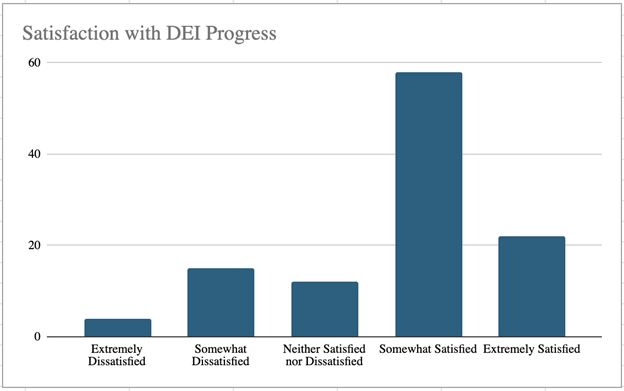
We found North Carolina’s nonprofits are most responsive to internal stakeholders (like employees and service recipients), and some external stakeholders (like local communities) when considering their commitment to DEI. We also found that receiving government funding did not have a significant impact on whether the organization had a DEI policy or statement in place. This is interesting, given that DEI policies are evolutions of Affirmative Action policies, which have been government-mandated for many types of organizations, and have been stipulations of some grant funding. Additionally, North Carolina’s nonprofits increased their commitment to DEI even when it became a controversy at the state level.
So what?
Our findings suggest that North Carolina’s nonprofits remain responsive to their communities and the people they serve in the face of a swinging DEI pendulum. Regardless of what is happening at the state level, they remain true to their mission and purpose. When community support for DEI is strong, local legitimacy and social backing can work to counter political opposition that causes organizations to retreat from DEI work. Additionally, the importance of staff advocacy cannot be understated. As internal actors shaping organizational commitment to diversity and inclusion, staff help empower nonprofits to pursue DEI even in hostile or divisive environments. This means DEI outcomes within nonprofit spaces aren’t just a result of policy, but also depend on many factors like community support and internal advocacy.
These findings lead us to further investigate how nonprofits respond to such polarizing environments. Additionally, there may be differences in those responses across states who reside elsewhere on the DEI pendulum. We wonder what happens to co-creators, service recipients, donors, and other stakeholders when nonprofits are forced to reconsider how to best carry forth their mission. We believe nonprofit mission and purpose is inherently rooted in the values underlying DEI policies like, for example, social equity. We also wonder how those decisions are made and what additional impacts underrepresented groups are facing. If you work with or in a nonprofit organization that is struggling with how to adapt to the current political and social environment, or how to contextualize the work you’re doing in this environment, we’d love to connect as we think about next steps in terms of the future role of philanthropy.
Click here to read the free full-text article: Azevedo, L., & Beightley, J. (2026). Nonprofit Policies in an Anti-DEI Legislative Environment. Nonprofit and Voluntary Sector Quarterly, 0(0).
 NVSQ Blog