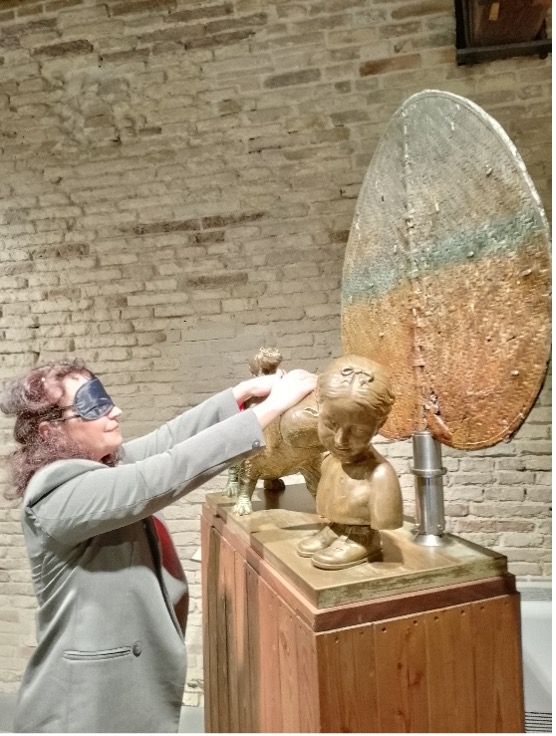
Photo of Baldarelli’s visit to Omero Museum Ancona-Italy (2024)
Maria-Gabriella Baldarelli1 , Eleonora Cardillo2
1University of Bologna (Italy), 2University of Catania (Italy)
Rethinking the Role of Cultural Institutions in Times of Uncertainty
The current state of the art presents situations of profound uncertainty for the future due to climate change and war conditions that generate a widespread feeling of fear. Therefore, the need is to rethink the role of public and private organizations and the meaning of creating networks that can lead to positive and hopeful circuits.
Part of the literature positions art as an important antidote to fear. Furthermore, we question the problems of resilience in cultural institutions trying to discover the dynamics that allow the continuation of the use of art works, identifying dimensions that can support it. To try to participate in this debate is important to contribute to investigating relationships between new technologies and fruition management in cultural institutions in order to promote inclusion for a more sustainable society. Cultural institutions, such as museums, play an essential role in generating social inclusion in order to push a broader cultural change.
Technology, Inclusion, and Vulnerability
New technologies are playing an important role in this topic, because the relationships among social integration and technologies are crucial, in order to make the community sensitive regarding vulnerable people with special needs and for the creation of a new paradigm of sustainability.
Furthermore, many research works are mainly focused on the role of technological innovations in supporting inclusion without specifying the type of “vulnerability”, which instead is very important in making products, including the cultural ones, shared and usable.
Moreover, literature involved digitalization in the context of museums in general, but the aspects concerning inclusion and the possibility, through digitalization, of promoting a broad-spectrum of cultural change are less considered.
Continue reading “The challenge of Touching Art and Technological Innovation Management Models for a More Inclusive Society”

 NVSQ Blog