
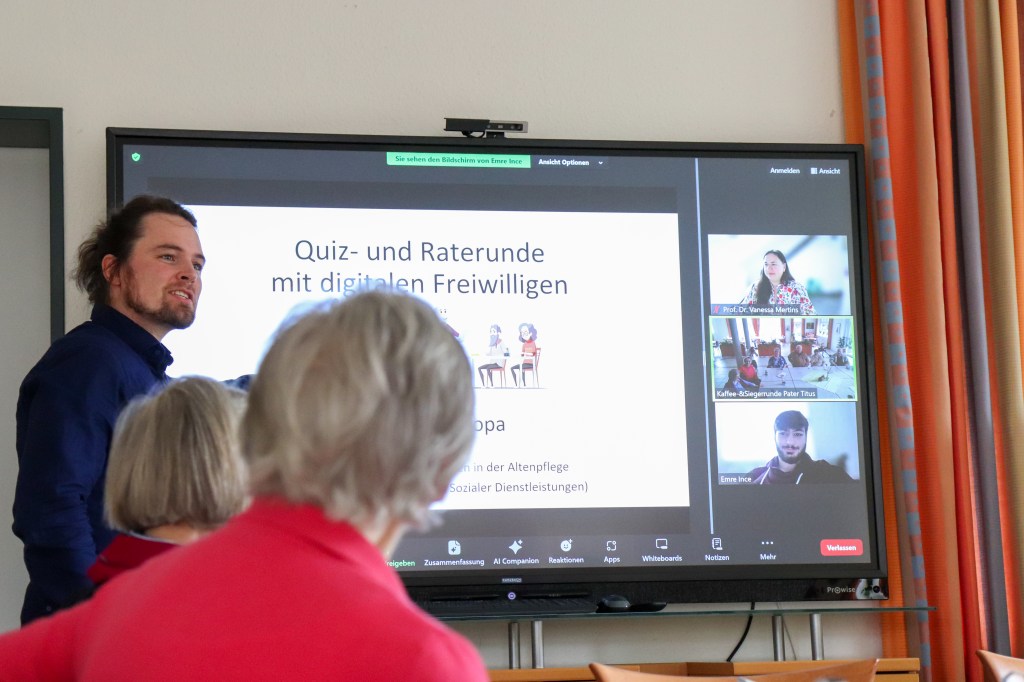
Photo provided by Dr. Hiller
Maximilian Hiller, Devin Kwasniok, and Vanessa Mertins
University of Vechta, Germany
Nonprofits invest real effort in bringing new volunteers into the fold. They refine their messaging, polish their outreach, and try small gestures to make the first step feel welcoming. A branded mug on someone’s desk, a handwritten note slipped into an envelope, or a modest voucher added as a small token of appreciation. Alongside these gifts, they open simple entry points and reach out with an easy ask, hoping a small first yes makes the next one feel natural. All of this effort hinges on the idea that the right external pull helps someone cross the line into action.
Our study tells a quieter, more grounded story. We also expected that these strategies would help, and that the real question was simply which one worked best for sparking repeated engagement. Yet, when we put them to the test in a natural field experiment, their influence proved far smaller than expected. People were not moved by gifts, nor by the light lift we offered. They followed the call because the cause was clear and meaningful. The mission itself did the heavy lifting.
What did we do?
To understand how established interventions, such as offering gifts or planting a foot-in-the-door approach, work in real-world settings, we partnered with a nonprofit that creates volunteering opportunities for the benefit of older adults. Our study drew on data from over 500 individuals who took part in an independent health-tracking study and had no affiliation with the NPO. Everyone first received a message telling them that their weekly step counts would be used in a lighthearted guessing game for seniors in care facilities. A week later, we shared the result of that game and used this moment to introduce the nonprofit that would turn the material into actual quiz content. After the introduction, participants were randomly assigned to one of three versions of the message. One included a small voucher framed as a gift from the nonprofit. Another offered the same voucher but combined it with a brief request. The third contained no voucher. Apart from this, the messages were identical. Seven days later, we forwarded a call-for-volunteers on behalf of the nonprofit to all participants, inviting them to participate in a digital volunteering activity. Over the following seventeen days, they could send in small pieces of content based on simple, preassigned daily themes. These submissions became digital quiz rounds for older adults, such as a pet photo with “What breed is this?” or a snapshot from a walk with “Where might this be?” They could contribute on as many days as they wished.
What did we find?
Across all groups, participation was surprisingly strong. Almost one in six people contributed at least once. This level of take-up is higher than what is typically seen in outreach to completely new audiences. When we compared the groups, the picture became clear: those who received a gift, those who were kindly asked for a small favor and those in the control condition engaged at almost identical rates. The differences were small, hovering around 16 to 18 percent. A simple, conceptual figure of our results would show three bars, all nearly the same height. You can see this in our full NVSQ article: No Gifts, No Strings: How a Good Cause Stands on Its Own
What did stand out, however, was the role of the mission itself. Participants’ ratings of the NPO were a strong and consistent predictor of how much they contributed across all measures. The more meaningful the NPO felt to them, the more likely they were to take part. Surprisingly, prior volunteer experience did not help explain engagement in this setting. This suggests that episodic, low-barrier volunteering may follow a different logic than more sustained forms of engagement, where experience usually matters.
So what?
For practitioners, the message is both encouraging and straightforward. In our study, small gifts and the foot-in-the-door technique did not significantly impact overall engagement, but it remained high nonetheless. This suggests that when people understand the value of a mission and see a clear, low-barrier way to contribute, they step in without needing much persuasion. For NPO managers, this means that time and resources may be better spent on highlighting the purpose of the work and lowering the threshold for initial involvement rather than perfecting the framing of initial outreach. Make it easy for people to lend a hand. Show them who benefits. Offer a first step that feels light, meaningful, and doable. The key insight is that clarity of mission can outweigh supplementary interventions. When participants understand the cause and the effort required feels manageable, individuals without prior affiliation can still be motivated to take part.
Click here to read the free full-text article: Hiller, M., Kwasniok, D., & Mertins, V. (2025). No Gifts, No Strings: How a Good Cause Stands on Its Own. Nonprofit and Voluntary Sector Quarterly, 0(0). https://doi.org/10.1177/08997640251397659
 NVSQ Blog