
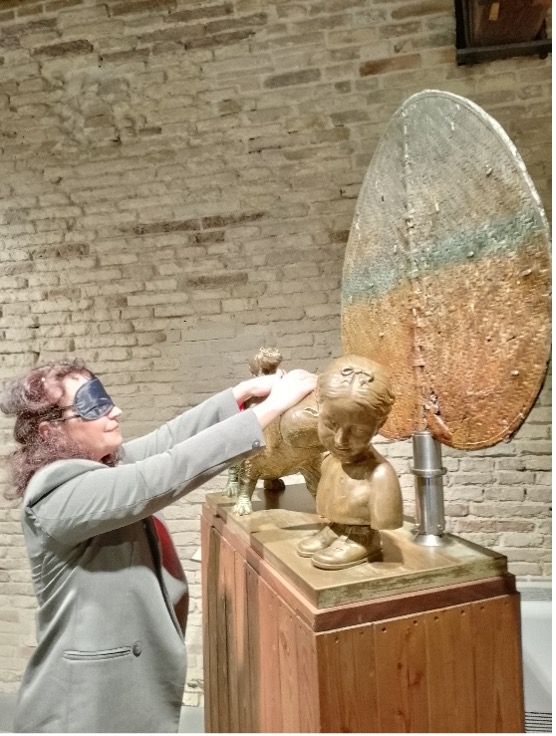
Photo of Baldarelli’s visit to Omero Museum Ancona-Italy (2024)
Maria-Gabriella Baldarelli1 , Eleonora Cardillo2
1University of Bologna (Italy), 2University of Catania (Italy)
Rethinking the Role of Cultural Institutions in Times of Uncertainty
The current state of the art presents situations of profound uncertainty for the future due to climate change and war conditions that generate a widespread feeling of fear. Therefore, the need is to rethink the role of public and private organizations and the meaning of creating networks that can lead to positive and hopeful circuits.
Part of the literature positions art as an important antidote to fear. Furthermore, we question the problems of resilience in cultural institutions trying to discover the dynamics that allow the continuation of the use of art works, identifying dimensions that can support it. To try to participate in this debate is important to contribute to investigating relationships between new technologies and fruition management in cultural institutions in order to promote inclusion for a more sustainable society. Cultural institutions, such as museums, play an essential role in generating social inclusion in order to push a broader cultural change.
Technology, Inclusion, and Vulnerability
New technologies are playing an important role in this topic, because the relationships among social integration and technologies are crucial, in order to make the community sensitive regarding vulnerable people with special needs and for the creation of a new paradigm of sustainability.
Furthermore, many research works are mainly focused on the role of technological innovations in supporting inclusion without specifying the type of “vulnerability”, which instead is very important in making products, including the cultural ones, shared and usable.
Moreover, literature involved digitalization in the context of museums in general, but the aspects concerning inclusion and the possibility, through digitalization, of promoting a broad-spectrum of cultural change are less considered.
The Importance of Touch in Experiencing Art
The experience of simply viewing works of art is partial, and the ability to touch them is essential to completely and fully enjoy cultural heritage and products. The case of tactile museums demonstrates how these institutions constitute places of growth and social regeneration for the entire community. People with disabilities in some contexts become vulnerable subjects or groups due to inadequate facilities or the presence of physical or cultural barriers that limit enjoyment and accessibility. The theme of social responsibility of organisations and civic community towards vulnerable people underlines how managerial innovations are linked to a constant commitment to inclusion and sharing. Accessibility and enjoyment of art are part of the debate on the ethical tasks of civil society, which sees the non-profit sector among its main actors, but which is open to welcoming networks composed of public and private, profit and non-profit organizations, to go beyond traditional paradigms and propose shared and creative solutions.
The Omero Tactile Museum Case Study
The evaluation of inclusive processes and the impact of new technologies for emancipatory change is explored in the study by Baldarelli and Cardillo (2025), conducted at the Omero Tactile Museum in Ancona.
The selection of this case is significant for several reasons:
- Commitment to Cultural Change: The museum actively pursues a vision of inclusion through touch-based artistic experiences.
- Networked Collaboration: It creates strong networks among non-profit organizations, public administration, and private firms, acting as engines of emancipatory change.
- National Recognition: In 1999, the Italian Parliament officially recognized the Omero Tactile Museum as a State Museum, confirming its unique national value while maintaining its not-for-profit activity.
Additionally, the case analyzed is activating national and international educational networks at different levels, such as: primary schools, secondary schools, universities with ERASMUS+ and EU projects. In this way, it is spreading the culture of inclusion and the importance of the use of the sense of “Touch” for all people. These activities are able to promote the basic condition for more justice and peace. It is a sort of “provocation”, because literature about heritage is moving beyond the concept that it is sufficient to visualize in order to experience art. As Grassini, current President of OTMA, underlines:
“The blind can make them remember that touch belongs to everyone, even to those who see, and the beauty of touching can give them back the pleasure of an ancestral experience that enriches living with a newfound color as well. We must therefore consider that the importance of tactility from a cognitive point of view adds an equally relevant aesthetic value”
Managerial Innovation for Inclusive Cultural Institutions
Considering that the management of tactile museums and cultural institutions in general is complex, the analysis conducted sought to offer tools for evaluating managerial strategies and choices in these entities. The introduction of new technologies, as well as all managerial innovations, is part of a specific cultural context characterized by different purposes and categories of users. To this end, understanding the relationships between innovation and inclusion represents a fundamental step for private bodies and public institutions that operate in this area and wish to contribute to social change within their territorial context.
The proposed model represents a managerial tool to connect the finalistic dimensions underlying the introduction of technological innovations to the museum context, evaluating their effects with respect to the inclusion and social regeneration of both the sighted and blind communities.
Expanding Impact: From Place to Global Reach
The case study illustrates how a managerial model can evolve through increasingly expansive concentric circles.
In the core circles, is the physical place: Ancona-Mole Vanvitelliana, in which to experience the tactile museum and so too the laboratories and workshops that have been described. In the outer circles, the case instead expands to consider the aspects of education for inclusion and the culture of touch from a spatial point of view, including European and non-European countries.
The other dimension is the temporal one which propels this “small museum” toward a strategic level enabling its participation in educational projects such as: In-VisiBLe which lays the foundations for an increasingly inclusive cultural change and is the engine of a radical change toward new sustainable paradigms.
Click here to read the free full-text article: Baldarelli, M.-G., & Cardillo, E. (2025). Touching Art and Technological Innovation Management Models for a More Inclusive Society: Theory and Practice. Nonprofit and Voluntary Sector Quarterly, 0(0). https://doi.org/10.1177/08997640251375972
 NVSQ Blog