
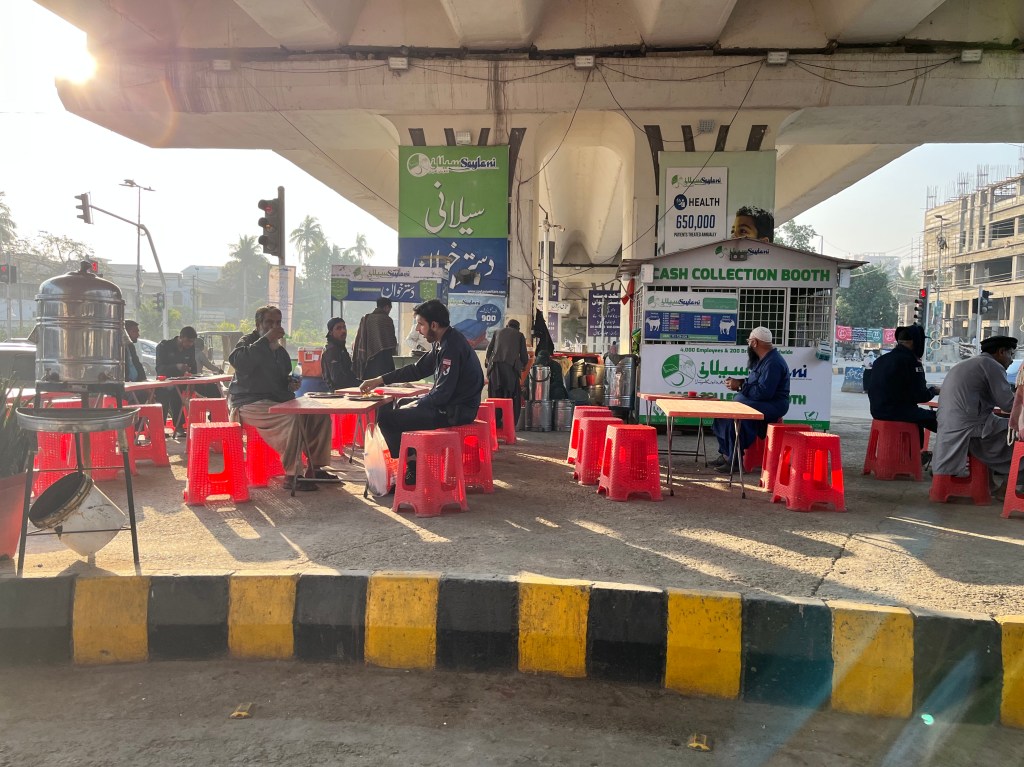
Photo from Dr. Kalia’s field work
Sumrin Kalia1 and Gregory Jackson2
1Freie Universität Berlin, Germany, 2King’s College London, UK
Often when we think of non-profits, we tend to focus on efficiency, organizational image, or fundraising. However, these organizations also play an important social role, leaving lasting impacts on the relationships, values, and social boundaries that shape civic life. They can promote inclusion, justice, and enable dialogue across social boundaries, but the opposite may also be true.
What can civil society organizations do to enable a coexistence that values justice over exploitation, cooperation over conflict, and inclusion over exclusion?
This question anchors our recently published article, “Organizing Civility: The Ethics of Adab in an Islamic Welfare Organization”. We look at the case of ‘Saylani Welfare Trust’ an Islamic welfare organization that engages in what we call ‘practices of civility’. Saylani draws inspiration from Sufism a mystical tradition of Islam that emerged in the eighth century.
In South Asia, Sufi shrines are well known for nurturing inter-religious harmony. Unlike traditional spaces of worship, such as temples, churches, or mosques, which are often marked by the boundaries of religion, shrines remain open to everyone. People from different religions, classes, and ethnicities come to express their devotion and seek the saint’s blessings. They engage in several collective rituals such as the annual death anniversary celebrations, offering flowers, shrouds, and money, and sharing food at the Langar the communal meal served to all visitors.
The Langar is a collective ritual of eating together while sitting on the floor. Shared across Sufi and Sikh traditions, it has a long history as a symbol of equality and hospitality. Visitors from all walks of life – rich and poor, men and women, Hindus, Sikhs, and Muslims – form lines, sit cross-legged on floor mats, and eat together from metal plates while volunteers walk around serving food. They also make small donations, which are used to sustain the kitchen year-round. Such communal sharing of food—eating and giving—creates a sense of belonging and nurtures an ethic of reciprocity.
On the streets of Karachi, Pakistan’s largest city, this practice has taken a creative turn in the form of the Dastarkhwan — free food spreads that echo the spirit of the Langar in a more urban setting. These are makeshift outdoor eating areas equipped with tables and chairs arranged around a central stall. This practice was pioneered by Saylani Welfare Trust, founded in 1999 as a small ambulance service operating out of a wooden cabin at a roundabout in Karachi. Soon after its founding, Saylani began installing free food spreads across the city. Meals are prepared offsite in central kitchens and delivered to these sites, where the staff serve anyone who arrives, three times a day. Strategically located under bridges, along sidewalks, and in busy intersections these food spreads are easily accessible to all.
This was a time when neoliberal reforms were reshaping Karachi’s class structure. As the middle class expanded, the city drew waves of workers from across the country, many of whom settled on its peripheries and spent long hours commuting through the city’s broken public transport system. For these labourers, the free food spreads became a respite. They could access a warm meal without travelling long distances or spending their limited income on overpriced street food. Soon, these spaces began attracting day labourers, security guards, street vendors, and commuters, anyone who needed food and rest during the workday.
At mealtimes, the food spreads grow crowded. The staff must manage these moments with great care, since such spaces can easily become chaotic. People are hungry and, in a rush, so patient behaviors can’t be taken for granted. The staff gently greet the visitors instructing them to form queues. Then they move calmly through those queues, reassuring everyone that there will be enough food and a place for each person to sit. In doing so, they model patience and humility, setting the tone for respectful interaction among the hungry and the hurried. Visitors are gently reminded not to linger too long so that others can also eat.
Over time, these food spreads have become spaces of thin interactions not only among those who eat there but also among those who pass by. Many visitors come these spaces daily, which enables frequent encounters with the staff and others who share the food spread. These minimal yet meaningful interactions foster a sense of familiarity and mutual reciprocity. For the wealthy who do not eat at the food spread, but drive past it, the sight of people waiting patiently in long queues, serves as a reminder of the city’s inequality as well as generosity.
Yet this generosity does not come automatically, it has to be cultivated. Big, divided cities with poor infrastructure, high levels of inequality, and immense diversity — such as Karachi — are places where differences of class, religion, and ethnicity always run the risk of turning into exploitation, conflict, and exclusion.
Organizations like Saylani play a crucial role in guarding against such risks. Saylani not only draws from the cultural practices of Sufism but also from its ethical framework, Adab—a set of moral guidelines grounded in virtues such as humility, modesty, patience, gratitude, moderation, and trust in God. It does not only feed the poor; it also serves as a model for cultivating self-restraint, cooperation, and inclusion. Not just among the poor but among the rich as well.
For instance, when the patrons of Saylani meet donors, they emphasize that giving is not an act of charity but of sharing. This reframing matters. Charity assumes a hierarchy between the giver and the receiver. Sharing, by contrast, can take place among equals — among family, friends, neighbours, or colleagues. This reframing of charity softens symbolic hierarchies of class and fosters a sense of mutuality and respect. Saylani organizes fund raising events in which both donors and recipients are invited. The chairman and patrons insist on being the first to greet everyone, because this signals humility and gratitude. Donors, too, are encouraged to greet the receivers, who in turn respond with gratitude. These simple gestures set a tone of reciprocity.
These practices have important consequences for social relations. When we interact with humility, we soften the hierarchies of class. When we practice patience, we reduce the chances of conflict. When we make space for others — by greeting them first, offering help, or saving someone else’s time — we foster cooperation. The more people embody and internalize these virtues in their daily interactions, the more they change social relations making them more cooperative, equal and grounded in mutual respect.
The food spreads dotted across the city’s infrastructure, serve as living reminders of the Langars of Sufi shrines. The form has changed, mats on marble floors have become rows of plastic tables under flyovers, but the meaning remains the same. These are spaces where Sufi ethical framework of Adab continues to be a source of ideas and values that help sustain ‘civility’ in social interactions. Civility here is not a top-down civilizing force but a set of virtues such as humility, modesty, patience, and gratitude which shape social relations.
What we found most interesting about Saylani is how it embeds its virtues and ideas of civility within familiar cultural practices. By bringing people together – at the food spread or the fundraising dinner – and inviting them to share food and space while embodying the virtues of humility, patience, and respect, Saylani harnesses the capacity of culture to facilitate thin yet meaningful interactions. Cultural practices provide the material form and social infrastructures in which virtues of civility – that remove hierarchies, expand solidarities, and promote inclusion – are anchored. The thin interactions enabled through these practices can bridge social divides. While such practices may not transform the socio-economic structure of the society, they lay the groundwork for civil repair.
Click here to read the free full-text article: Kalia, S., & Jackson, G. (2025). Organizing Civility: Bridging Practices in Islamic Welfare Organization. Nonprofit and Voluntary Sector Quarterly, 0(0). https://doi.org/10.1177/08997640251387984
 NVSQ Blog