

Photo by Antoni Shkraba Studio on Pexels.com
Tine Faseur1 , Tine De Bock1 , and Glenn Timmermans2
1KU Leuven, Belgium, 2Hogeschool PXL, Hasselt, Belgium
Why this study? What is it about?
Imagine receiving an email with a donation request from a charity you have never donated to before. The message is urgent, the images are emotional, and the request is clear: donate now. But as you hover over the “donate” button, questions arise. How did they get your contact information? Where exactly will your money go? Is this emotional appeal crossing an ethical line?
Fundraising ethics has become a growing concern as the professionalization of fundraising and the use of marketing techniques have expanded. To address these concerns, nonprofit organizations and professional associations have developed ethical codes that outline best practices for fundraisers. However, these guidelines are primarily created from the perspective of fundraising professionals, leaving a critical gap: how do individual donors—arguably one of the most essential stakeholders—perceive the ethics of fundraising? Despite the nonprofit sector’s dependence on individual donors, research on their ethical views remains scarce. This study fills that gap by exploring what drives donors to perceive fundraising practices as ethical or unethical.
What did we do?
Given the in-depth nature of our research question and the limited existing literature on the topic, we conducted qualitative interviews with 52 individual donors from diverse backgrounds to explore their ethical beliefs in fundraising. This method allowed us to uncover deep insights into donors’ perceptions and motivations—elements that standardized surveys often fail to capture. To ensure an open and flexible discussion, we designed our interviews with broad, open-ended questions and gave interviewers the freedom to deviate from the guide when responses required clarification or elaboration.
To structure our study, we first identified key themes in fundraising ethics by analyzing ethical codes used by various fundraising organizations. These themes guided the development of our interview guide, covering topics such as donor solicitation practices, messaging, data management, financial transparency, and the compensation of fundraising staff. We began each interview with general questions about participants’ donation behavior before allowing them to freely share their thoughts on fundraising ethics. In the second phase, we systematically explored each theme.
What did we find?
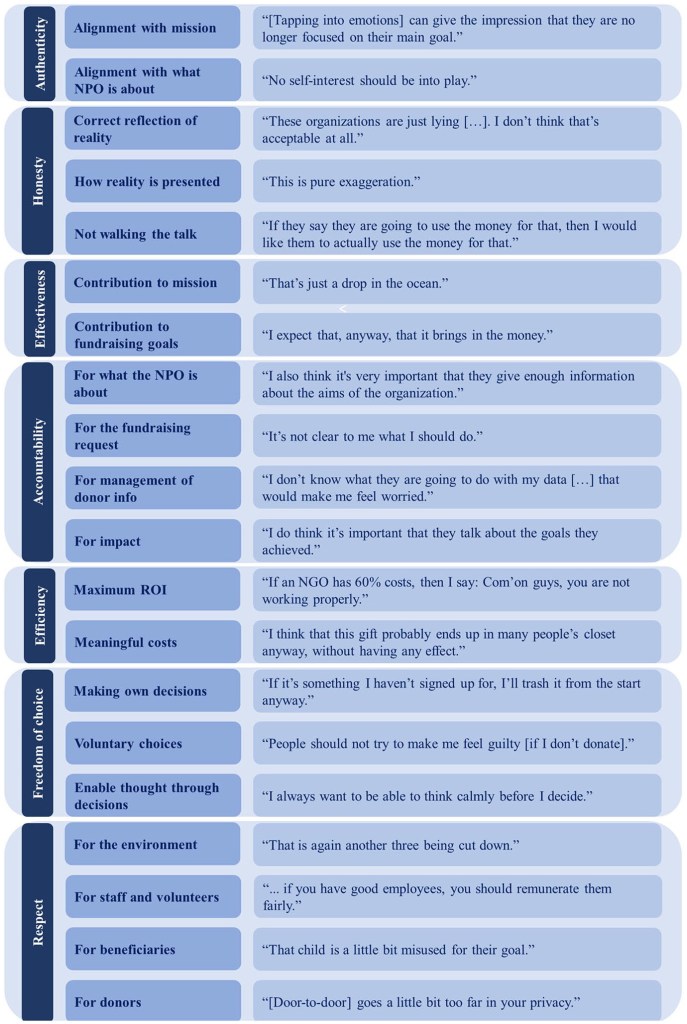
Our analysis of 52 in-depth interviews uncovered seven key factors that shape how donors judge the ethics of fundraising practices: authenticity, honesty, effectiveness, accountability, efficiency, freedom of choice, and respect. Each of these factors plays a role in shaping donors’ perceptions, with some breaking down further into specific aspects that influence whether a practice is seen as ethical or not. In the figure below, we’ve mapped out these insights in a clear, structured way. Interestingly, we found no connections between donors’ ethical views and personal characteristics such as gender, age, donation motivation, or the type of nonprofit they support.
So what?
Beyond contributing to the academic understanding of fundraising ethics, our findings have important practical implications for the nonprofit sector. This study is the first to offer a detailed look at the factors that shape donors’ ethical beliefs about fundraising, giving professionals a deeper understanding of what it truly means to be donor-centric. Since there’s no single type of donor, fundraisers cannot simply adopt a one-size-fits-all approach. However, the insights from this study can help start more informed conversations about ethics when planning, implementing, and evaluating fundraising campaigns.
To spark such discussions, we created a checklist based on the seven key factors we identified. This checklist forms a great starting point for nonprofits to reflect on the ethical dimensions of their work and consider donors’ perspectives. With these insights, nonprofits can explore which ethical factors matter most to their specific donors, and juxtapose these with the perspective of the organization or any other stakeholder. Future research could build on this by developing measurement tools for each of these drivers, helping fundraisers better understand how their practices align with donors’ values.
Click here to read the free full-text article: Faseur, T., De Bock, T., & Timmermans, G. (2025). Fundraising Ethics: Toward an In-Depth Understanding of Individual Donors’ Perceptions. Nonprofit and Voluntary Sector Quarterly, 0(0). https://doi.org/10.1177/08997640251314376
 NVSQ Blog